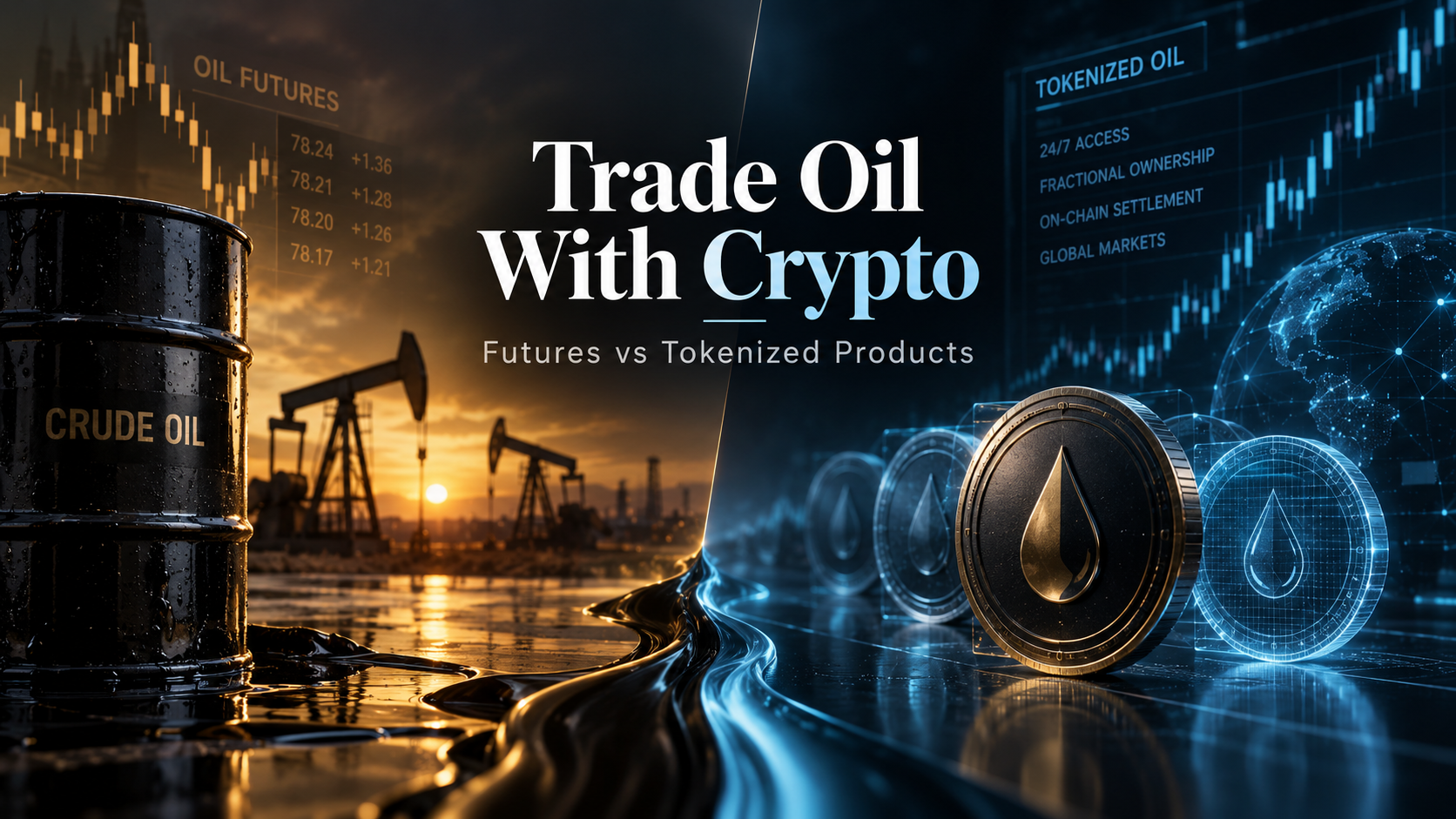
Quick Answer
USDT-margined oil futures generally suit active traders who want to go long or short, use leverage, hedge short-term moves, and keep collateral in crypto. Tokenized oil products are more suited to users who want spot-like, on-chain oil exposure without leverage-driven liquidation. Neither structure is inherently “safer”: futures carry leverage, liquidation, and funding costs, while tokenized products carry issuer, custody, smart-contract, redemption, and liquidity risk. For beginners, product structure matters more than maximum leverage or round-the-clock access.
Key Takeaways
- Crypto users can now gain crude-oil price exposure without opening a traditional commodities brokerage account.
- The two dominant routes are crypto-settled derivatives and emerging tokenized commodity products.
- Futures tend to be stronger for active trading; tokenized products are potentially stronger for holding or on-chain use.
- “Tokenized oil” isn’t one standardized product. Backing can rest on physical commodity claims, futures contracts, or other reference structures.
- Always verify benchmark, liquidity, trading hours, fees, collateral, and redemption terms before committing capital.
Crude oil is one of the more geopolitically sensitive assets to trade, reacting to OPEC+ decisions, inventory data, shipping disruptions, and dollar swings. Crypto-native traders once needed a separate commodities brokerage account to get exposure to WTI or Brent. That’s changing: exchanges and real-world-asset (RWA) projects now increasingly offer oil exposure through stablecoin-settled contracts or blockchain-based tokens. If you’re already holding USDT or USDC, the practical question is whether to trade oil through perpetual futures or buy into a tokenized product, and the two behave very differently.
Several exchanges moved into oil derivatives this year: MEXC listed USDT-margined USOILUSDT and UKOILUSDT commodity futures in January 2026, later rebranding them OIL(WTI) and OIL(BRENT), while Binance and the decentralized venue Hyperliquid rolled out comparable oil perpetuals of their own.
What Are the Main Ways to Trade Oil With Crypto in 2026?
Two structures dominate the space.
1. USDT-Margined Oil Perpetual Futures
These are derivative contracts that track the WTI or Brent benchmark, with margin, profit, and loss all denominated in USDT. Traders can go long or short, often with leverage, but never take ownership of physical crude. MEXC’s OIL(WTI)USDT listing, for example, currently advertises leverage as high as 200x on its smallest risk tiers, though caps like this shrink as position size grows and change over time (the contract launched with a 20x cap in January before limits were later raised). If you want to trade Perpetual Oil Futures, the benefit is capital efficiency and easy access to short positions; the risk is that leverage amplifies losses and can trigger liquidation quickly.
2. Tokenized Oil Products
These are blockchain-based assets designed to represent or track oil exposure. Backing models vary meaningfully: some claim to be backed by physical commodity reserves, others by futures positions held behind the token, and others are simply synthetic or reference-price instruments with no hard backing at all. The upside is potentially simpler, unleveraged, transferable on-chain exposure; the downside is that holders are relying on an issuer, its custody arrangements, and often-thin secondary-market liquidity.
How Do Crypto Oil Futures Work, and Who Are They Best For?
Opening a Position
A typical workflow: deposit USDT collateral, select a WTI or Brent contract, choose long (betting the benchmark rises) or short (betting it falls), set margin mode and leverage, enter the position, manage a stop-loss, then close back into USDT. Before trading, understand the difference between cross and isolated margin, how mark price and liquidation are calculated, and the contract’s minimum order size.
Costs and Market-Hours Caveats
Costs include maker/taker fees, funding or carry charges, spread, slippage, and liquidation fees. One common misconception is that commodity-linked crypto contracts run 24/7 simply because they sit on a crypto exchange. Some do; decentralized platforms like Hyperliquid market continuous oil trading. But others follow the underlying commodity market’s own schedule. MEXC’s original USOIL/UKOIL listing, for instance, specified weekday trading sessions with daily suspension windows aligned to the underlying market, and funding-rate settlement frequency has been adjusted more than once since launch.
Best suited to: active traders, hedgers, and anyone who needs quick directional or short exposure.
Main risks: liquidation, leverage, price gaps around trading suspensions, tracking differences versus the physical benchmark, and exchange counterparty risk.
How Does Tokenized Oil Work, and Is It Really Backed by Oil?
The Main Backing Models
The word “tokenized” hides a lot of structural variation. WTIC, issued by Energy Substantiation Partners, represents each token as one barrel of WTI crude, backed by what the issuer calls Volumetric Energy Receipts held with an independent custodian and audited monthly, with tokens minted using USDC and redeemable daily for USDC or, in principle, physical delivery. Ozel takes a different route, describing its token as backed 1:1 by oil held inside a futures contract and verified through zero-knowledge proof-of-reserves, though its total value locked and trading volume remain tiny, a useful reminder that this category is still early-stage. At the institutional end, regulated prime broker GCEX added a tokenized WTI/USD instrument to its platform in June 2026 with a 20% margin requirement, showing that not every tokenized product is unleveraged, and some remain restricted to professional clients in specific jurisdictions.
What Investors Actually Need to Verify
Before buying a tokenized oil product, check: what legally backs each token; who custodies the underlying assets; whether retail holders can actually redeem, and at what price; how liquid the secondary market really is; which blockchain the token lives on; and whether its smart contracts have been independently audited.
The benefit of this route is exposure without mandatory leverage, and potential composability inside DeFi. The risks are issuer insolvency, custody failure, redemption restrictions, tracking error or depegging, smart-contract exploits, and shallow liquidity.
Oil Futures vs. Tokenized Oil: Which Is Better?
| Factor | USDT Oil Futures | Tokenized Oil |
| Primary purpose | Trading / hedging | Holding / on-chain exposure |
| Own underlying oil? | No | Depends on backing structure |
| Long exposure | Yes | Usually yes |
| Short exposure | Usually easy | Often difficult |
| Leverage | Often available | Usually none, though some issuers apply margin |
| Liquidation risk | Yes, with leverage | Normally no leveraged liquidation |
| Main ongoing cost | Trading fees + possible funding/carry | Issuance/redemption spread, gas, custody |
| Trading hours | Product-specific | Secondary markets may run 24/7 |
| Tracking | Index/derivative based | Depends on backing mechanism |
| DeFi compatibility | Limited | Potentially high |
| Key risk | Leverage / liquidation | Issuer / backing / liquidity |
| Better for | Active traders | Longer-term, on-chain-oriented users |
Futures generally offer more mature trading functionality; well-structured tokenized products may offer better ownership-like digital exposure. Neither should be assumed to be the “safer” choice by default.
Scenario Analysis: Which Oil Product Fits Different Crypto Traders?
“Oil may spike this week after a geopolitical event.”
Futures typically fit best. They allow immediate long or short positioning with stop-losses, and leverage if used deliberately. Volatility can also trigger fast liquidations.
“I want oil exposure for several months.”
A transparent, sufficiently liquid tokenized product may fit better, or low/no-leverage futures once funding and carry costs are compared against a token’s tracking accuracy and redemption terms.
“I already hold USDT and want to hedge falling oil prices.”
Futures again, because shorting is structurally far easier than trying to borrow and sell a tokenized oil product.
“I want oil as a real-world asset inside an on-chain portfolio.”
Tokenized products fit, provided reserves or backing can be verified, liquidity is adequate, contracts have been reviewed, and redemption terms are acceptable.
“I’m a beginner who just wants to speculate on oil.”
Avoid maximum leverage. A 200x cap being available is a platform feature, not a sensible default position size.
How to Choose an Oil-Crypto Product Before Trading
- What benchmark does it track? WTI and Brent don’t always move identically.
- What actually backs the product? An index, a futures position, a physical claim, or another collateral structure entirely?
- What are the real trading hours? Don’t assume a crypto interface means the underlying market never closes.
- What does holding the position cost? Compare fees, spreads, funding, gas, and redemption costs.
- How liquid is it? Check volume, order-book depth, and likely slippage.
- What else could cause a loss besides oil moving against you? Liquidation, counterparty failure, depegging, oracle failure, smart-contract exploits, or an inability to redeem.
Regional access matters too. Commodity derivatives and tokenized RWAs are often restricted by jurisdiction.
So, What Is the Best Way to Trade Oil With Crypto in 2026?
Choose USDT oil futures for short-term trading, hedging, or short exposure. Consider tokenized oil when the priority is unleveraged, on-chain exposure and you can independently verify the issuer’s backing and redemption model. For most retail traders, liquidity and risk controls should outweigh the appeal of maximum leverage. Tokenized oil is still an emerging category; established futures markets currently lead on trading infrastructure, even as tokenization looks like an important longer-term RWA model.
FAQ
Can you trade crude oil with USDT?
Yes. Several crypto derivatives venues offer WTI and Brent contracts margined or settled in USDT.
Is there a cryptocurrency backed by oil?
Yes, oil-linked and oil-backed tokens exist, but their backing structures differ substantially. Verify custody, reserves, and redemption terms rather than assuming every “oil token” represents direct ownership.
Can I trade WTI oil 24/7 with crypto?
Not always. Some tokenized secondary markets and decentralized perpetual venues run continuously, but exchange-listed oil derivatives can follow restricted trading sessions tied to the underlying commodity market.
Are oil futures better than tokenized oil?
For active trading and shorting, generally yes. For unleveraged or composable on-chain exposure, tokenized products may be the better fit.
Can you lose more than your deposit trading oil futures?
Leveraged derivatives can produce rapid losses and liquidation. Actual loss treatment depends on margin mode, platform rules, and each exchange’s risk-management systems.