Spring brings restoration work out of the corner of the shed
By mid-September across southern Australia, the cold that makes primer slow to cure and hands reluctant to hold a grinder is easing. Many restoration projects that waited through winter are now ready for rust repair and underbody work. A car rotisserie makes that work far easier by turning the whole shell on its side or upside down, and whether it does so with one hand or a struggle depends almost entirely on where the pivot sits.
A body turns easily only when the pivot runs through its balance point
Every car shell has a centre of gravity, the single point where its weight can be considered to act. If the car rotisserie’s pivot line passes through that point, the body is balanced in every position and a gentle push turns it.
If the pivot sits above or below that point, the shell behaves like a pendulum. It wants to swing its heavy side to the bottom, and turning it means lifting that weight around the axis. A badly balanced shell can also rotate on its own the moment a locking pin is pulled, which is exactly when hands and heads tend to be in the way.
Why a car body rotisserie adjusts its height at each end
The balance point of a stripped shell usually sits somewhere around the middle of its height, but exactly where depends on the model and on how much has been removed. Engine bays, floor pans and roof panels all shift it.
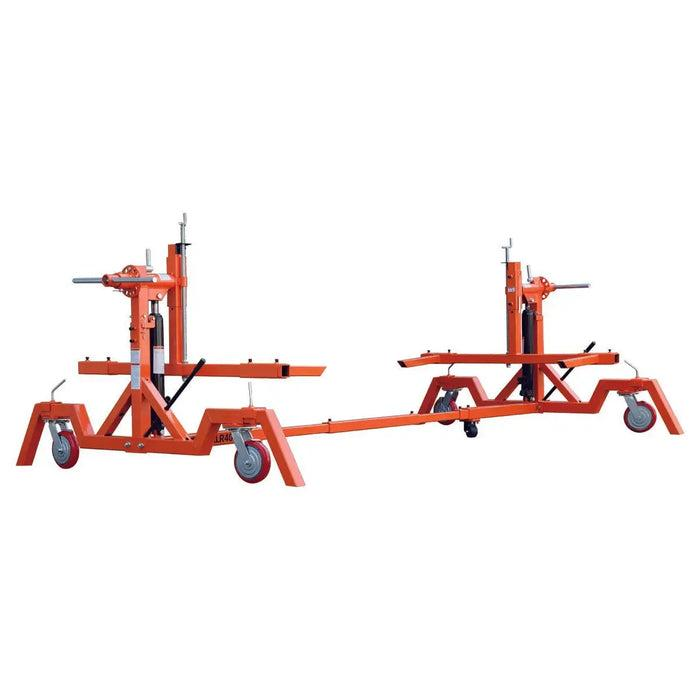
That is why a car body rotisserie lets the mounting arms move up and down at both ends. Raising or lowering the pivot until the shell sits still at any angle is the first job after mounting. Hydraulic cylinders then lift the whole assembly to a comfortable working height without disturbing that balance.
An unbraced shell will twist on the frame
A monocoque body gets much of its stiffness from its doors, roof and floor working together. Once rusted floor sections are cut out or door frames are opened up, the shell supported only at its two ends can sag or twist, and panels welded in that state will not line up later.
Welding temporary braces across door openings and between the front and rear mounting points before cutting anything keeps the geometry true. It takes an hour or so and saves a far longer fight with door gaps once the new panels go in.
Sorting restoration stands by how much of the car they expose
- Axle stands: fixed height, underside access only
- Tilt stand: rolls body partly, limited angles
- Auto rotisserie: full rotation, balanced on a pivot
- Chassis jig: holds geometry for structural repair
A car rotisserie gives full access for rust and paint work, while a jig belongs to structural repairs where measurements must be held. For a single project, a car rotisserie hire for the few weeks of underbody work can make more sense than a stand that then sits idle.
Balance first, then lock every time
Before working under a turned shell, insert the locking pin and test it by pushing gently in both directions. Balance makes turning easy, but it also means very little force is needed to move the body unexpectedly.
Anyone comparing a car rotisserie for sale should check the mounting brackets against the car’s bumper or chassis mounting points and allow a generous margin over the stripped shell’s weight. TMG Industrial offers rotisseries with dual hydraulic cylinders, and castors that lock firmly deserve as much attention as lifting capacity.