Somewhere in a studio, right now, a host is pulling numbered balls out of a machine in front of a few thousand people watching on their phones. It happens again about seventy seconds later. Then again. It’s been going all day and it’ll still be going at three in the morning.
Live game shows are one of the odder corners of the internet – part television, part arcade, running continuously with nobody presenting a schedule. Most people have scrolled past one. Very few have any idea what actually happens inside them, because the games themselves only remember the last handful of rounds.
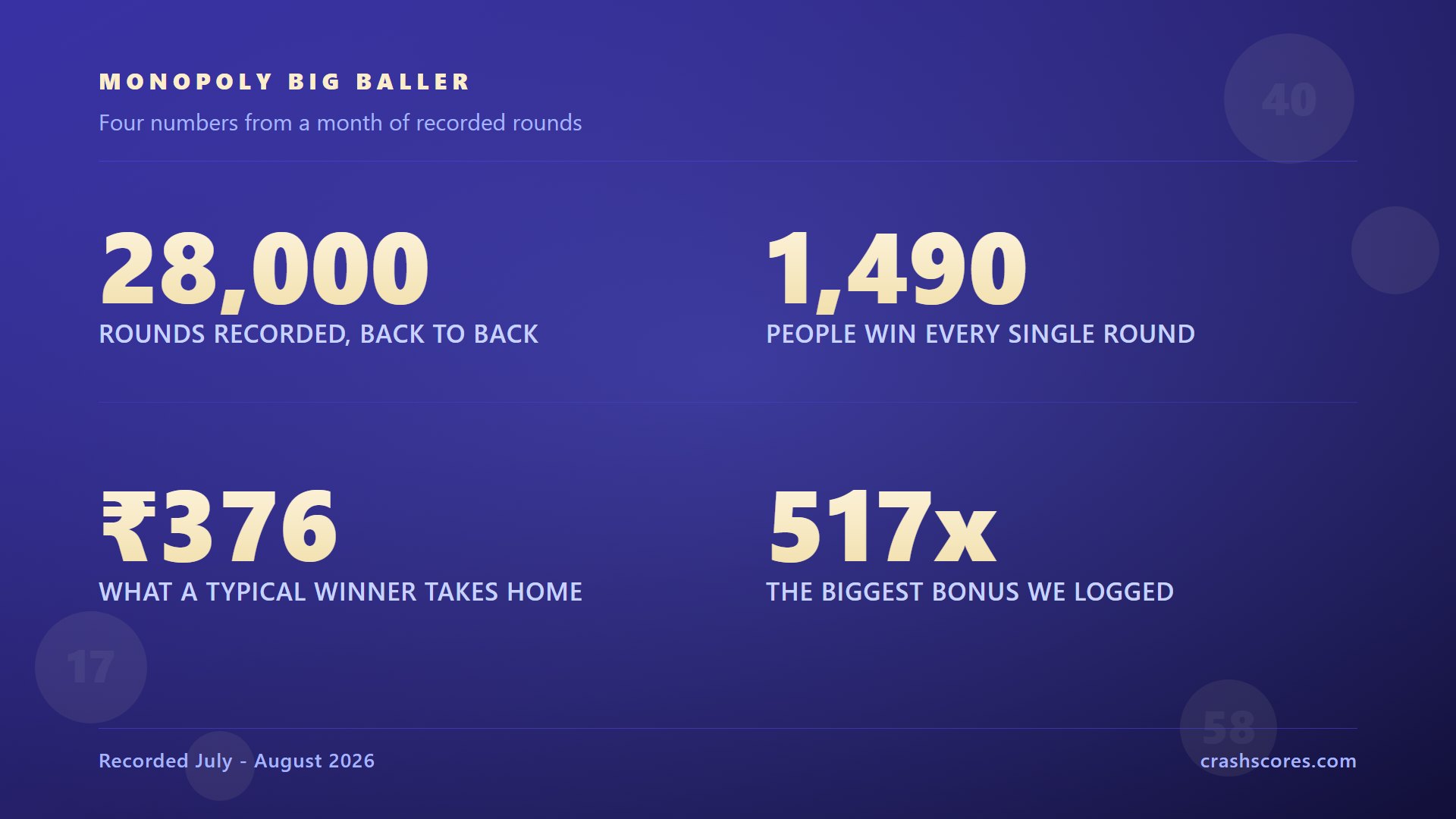
We kept the records instead. Between July and August 2026 we logged more than 28,000 consecutive rounds of one of the biggest of them, MONOPOLY Big Baller. Here is what turned up.
A round takes about 70 seconds
Which is faster than it feels while watching. Fifty-one rounds an hour, roughly 1,200 a day, every day, without a break.
The consistency is the surprising part. Half of all the rounds we recorded landed between 69.7 and 72.7 seconds apart – a three-second window across tens of thousands of rounds. Somewhere behind that is a studio running to a very tight clock.
About 1,490 people win each round
Not a handful. Not a jackpot going to one person. Nearly fifteen hundred winners, every seventy seconds, in a single game.
That number reframes what these things are. It looks like a game show, with the studio and the presenter and the tension, but structurally it behaves more like a very fast lottery with an enormous number of very small prizes.
The typical winner gets about ₹376
This is the number that surprised us most. A typical round pays out roughly ₹5.6 lakh in total, shared between those ~1,490 winners. Divide one by the other and the average winner walks away with about ₹376 – a little under four US dollars.
It’s worth sitting with that for a second, because it’s the opposite of how these games are presented. The clips that circulate are the enormous wins. The actual texture of the game is a thousand people each getting the price of a coffee.
The bonus round comes about every 22 minutes
The game has two bonus rounds, and they are what everyone is waiting for: 3 Rolls and 5 Rolls. Either one lands every 22 minutes or 1 in 19 rounds. 3 Rolls arrived roughly once in every 26 rounds – about 31 minutes of continuous play. The rarer 5 Rolls showed up about once an hour and a quarter, each 63 round. Both (3 Rolls and 5 Rolls) landing in the same round happened eight times in 28,000. That is roughly once every three days.
The biggest thing we recorded was 517x
3 Rolls bonus round paid out at 517 times the stake on it. The other bonus type – 5 Rolls – the one that is supposed to be the bigger prize – never got past 332x in the same period.
That inversion isn’t a mistake, and it is quietly instructive. The smaller bonus (3 Rolls) holds the record purely because it happened more often: 1,093 times against 459. More attempts, more chances at an extreme. Records are partly a measure of how many goes you’ve had.
Incredible “overdue” which can happen
We watched this game go 162 consecutive rounds without any bonus round once – against an average gap of eighteen rounds. About three hours with no bonus game! Incredible!
What a long record is genuinely good for is scale. It tells you what normal looks like and how far from normal any ordinary day can drift.
When a solid round history matters
Most trackers publish just today’s result history or even smaller – the last 20 draws. Almost everything above is invisible at that small length of data. Even if you take 72 hours round history, it is not big enough to see the whole picture. Decent casino statistics covers thousands of historical rounds, and it allows you to extract real-world numbers from it!